
Queer old Me - EP14
"So many things could go wrong. I could lose part of my sight. My face could end up paralysed, partially or fully. A stroke was also on the cards."

Queer Old me is an evolving queer memoir—written in real time—by a non-binary author navigating cancer, desire, and identity. It’s a sex-positive (sometimes raunchy), literary record of illness, intimacy, and becoming.
Start here | Previous episode | Next episode
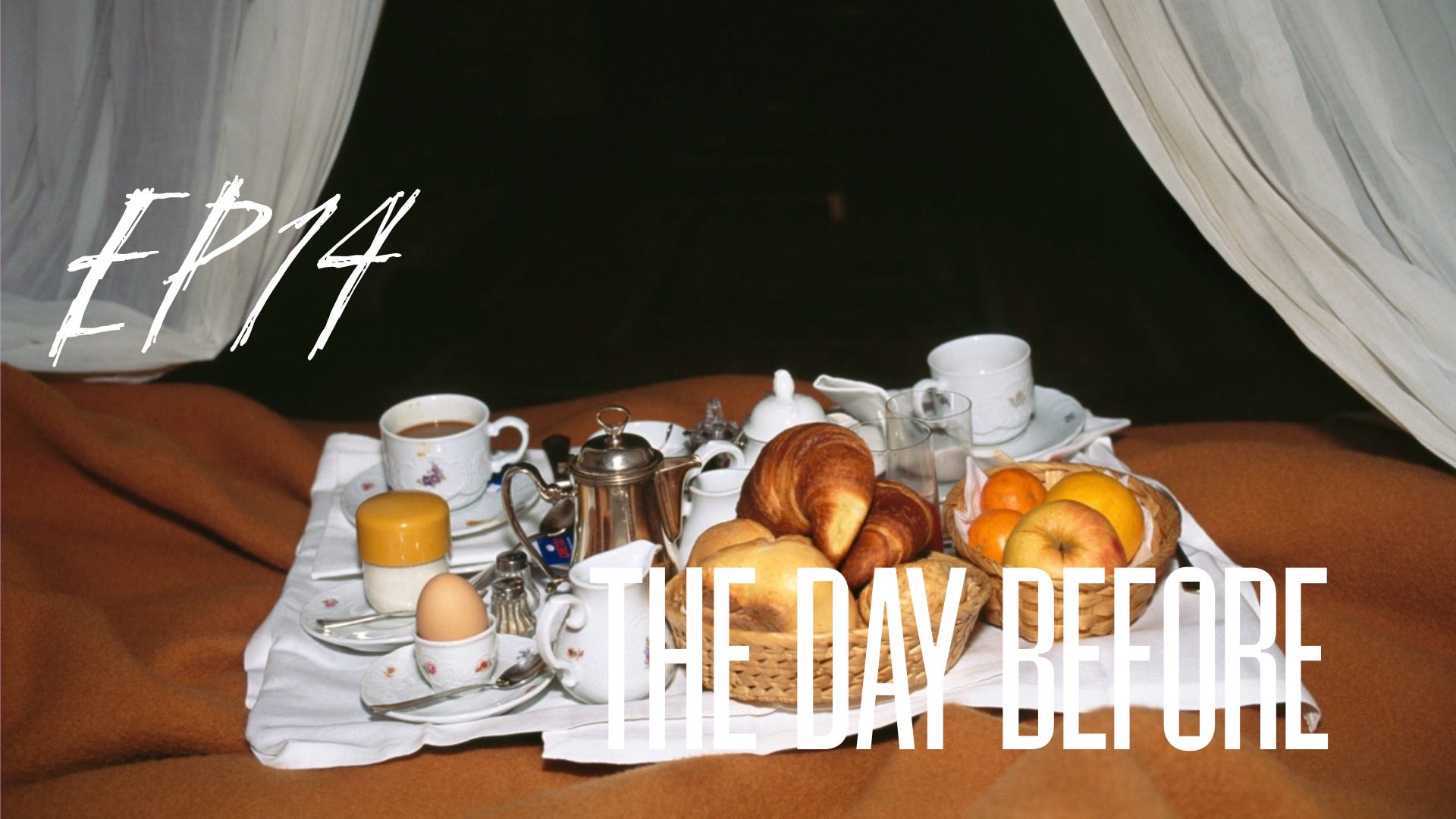
Nan Goldin, Breakfast in bed, Hotel Torre di Bellosguardo, Italy, 1996
The hospital loomed above me. I hadn’t had breakfast or coffee yet. “Hay que venir en ayunas, vale?” the nurse had told me. So, there I was en fucking ayunas. The smell of churros and hot chocolate from the food-truck wafted into my nostrils and triggered my hunger. I sped up. I bounded up the little hill and barged into the hospital. The sooner I got out, the sooner I’d get my coffee. I lined up behind an old couple and queued for the machine that gave you a number to start the real queue—ugh!
When my number got called, I wove in between cubicles and sat in front of a blond girl who welcomed me with a bright smile.
“Do you know why you are here today?”
I blanked.
“You speak Spanish, no?”
“Yes, yes! Of course, I do. We’re here to check my blood coagulation?” —what the fuck is coagulation? And where did I pick that up?
“It’s ok.” She smiled again. “So, we are gonna analyse your blood and make sure we understand it well.”
She spoke softly and used simple words. I was grateful.
“So if there is a need for a transfusion, we can give you the right blood. Does that make sense?” I nodded, and then I frowned. A transfusion? From years of watching medical dramas on television, I understood transfusions to first mean a significant loss of blood. Why would my head leak blood? And if it did happen which vegetable would I wake up as?
“Give me your arm. Are you afraid of needles?”
“I don’t think so.”
“And now close your fist.”
She fastened a rubber band around my bicep and slid a needle into my vein. I watched as the blood flooded vial after vial. Before I could say anything, she had grabbed my hand and tied a patient ID band around my wrist.
“This stays with you from now on, you can only take it off once you’ve been released from the hospital. Don’t worry, you can shower with it! It won’t break.”
As soon as the wristband locked, I felt trapped. What did she mean I couldn’t take it off? What did she mean I had to live my life with this bit of plastic on my wrist? I wanted it off me. It was too tight. It was itchy. It was scary.
She smiled and told me I could go. I stood up and left, my wrist imprisoned. I kept tugging at the plastic wristband, turning it over and over again. I sat on a bench and took a deep breath in. Deep breath in, small breath in, long breath out. I focused on the rhythm of my breath until the plastic stopped burning.
This was the first of many steps surrendering my autonomy and my independence. What this wristband was saying was: you belong to us now; you don’t get to have a say anymore. We will tell you where to go, at what time you need to be there, what to bring, what to wear, what not to wear and then we’ll hook you up to machines and strap you on the slab before we drug you and you pass out. Then we will manipulate your carcass, slide up your mouth, slash into your throat, pierce through your flesh and ram through your head until we’ve reached Little Bruno so we can grab some of him. You’ll wake up if you wake up.
So many things could go wrong. I could lose part of my sight. My face could end up paralysed, partially or fully. A stroke was also on the cards.
I was surrounded by people who told me that “Everything would be fine!”—I hated that line. And I hated it even more when it was followed by an obnoxious “I am sure of it!”
They were fucking sure of nothing because they didn’t know anything. Nobody fucking knew. Not them, not me and not even the surgeons. I fucking hated everybody for being so fucking cheery. Was that fair? I didn’t know. I didn’t give a shit.
Someone sat down next to me on the bench and lit a cigarette. It was the blond girl. She smiled kindly and said “¡Todo va a salir bien, verás! ¡Ánimo!” — I could have strangled her there and then. Instead, I thanked her and walked away.
As I turned the corner, a woman ran into the arms of her child “¡Dios mío! ¡Dios mío!” she cried. They embraced with urgency, grabbing onto each other tightly, and touching each other’s faces with trembling hands. I slipped past them and heard them whisper I love yous.
I should call my mum.
“Hi mum!”
“Mon chéri! Comment ça va?”
“I’m good! How about you?”
“Well, you know, the usual. Your brother’s coming for dinner tomorrow night. I invited François. Do you remember François? He worked with your dad, the pâtissier. You know he became a gardener. He works in that castle I like so much. Gosh, what is it called?” She spoke fast, as though she wanted to say a thousand things and simply didn’t have the time.
“Sure. But I was ten the last time I saw him. I vaguely remember long blond hair and a motorbike, maybe?”
“That’s it, that’s François. Though the hair is long… gone.” She laughed at her joke. “He’s bald like you now. I hated that motorbike, you know. It always worried me that something would happen. Well, I bumped into him in the supermarket. He doesn’t even live here anymore. Anyway, I invited him for dinner. I would love to have the three of you together in one room again. Such a shame, you’re so far.”
“Do you have like five minutes?”
“I’m leaving soon mon chéri, what is it? Everything alright?”
“If you’re in a rush out of the door, I’ll call you later.”
“Don’t be silly. What is it?”
“It’s ok. I’ll call you later.”
“Tell me. You’re not gonna call me later, you’re gonna tell me now.”
And so I told her about the shadow that became a tumour and about the biopsy.
“Science does wonders now, you know. Look at Simone, she has had both her knees changed and now she runs like a 75-year-old. This is just a biopsy. Don’t worry yourself too much. Is somebody going to be with you?”
“I have a friend taking care of me through it all. I have a good support system, you know. I have it all under control.”
“You’ve always been so resourceful. Can I have your friend’s number so that I can be in touch with him throughout the day?”
“I have thought of that too. He’s gonna make a WhatsApp group with everyone that knows so that you’re all up to date with how the surgery is going.”
“What’s his name?”
“I call him Cutiepie.”
“Are you two?”
“No, mum. He’s just a really good friend. Ok, I’ve gotta go.”
“Keep me informed, ok?”
“Yes, mum.”
“I love you mon chéri.”
“I love you too mum. It’s nothing, as you said, just a quick biopsy to make sure it’s nothing to worry about.”
I hung up. I still hadn’t had my morning coffee and we were closing in on noon. At this time tomorrow, my throat would be in the middle of being ripped open. I had been told little of the surgery. A general anaesthesia. An incision in my throat. That was the extent of what I understood. I had to trust blindly in people I didn’t know and hope for the best. Life had taught me that the best was never an outcome.
I took a Lorazepam, stopped at a cafe and finally got some caffeine in me. I decided against going home straight away. I sat at a table and laid my phone face down. I leaned against the chair and took in the view. The hospital stood tall on the other side of the street. An entire block of waiting rooms, offices, wards, operating theatres, and an ICU deep in its bowels—where I was supposed to wake up. I closed my eyes, took a long sip of my cup and savoured the hot liquid sliding down my throat. This would be my last coffee before the surgery.
New episodes Every Wednesday.
Start here | Previous episode | Next episode